
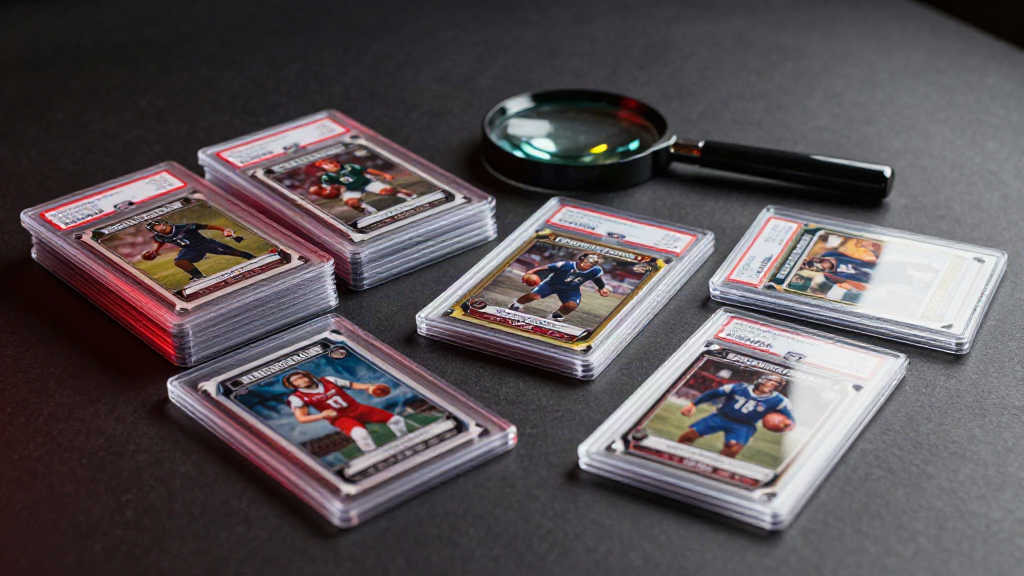
Grading trading cards is worth it only when one number comes out on the right side: does the graded sold price beat the raw sold price by more than the cost of getting there, plus the risk you eat along the way. Everything else is noise. Here is how to run that comparison before you seal an envelope.
Raw and Graded Cards Are Two Different Markets
Raw comps and slab comps do not move together. A raw card sells to a buyer who is pricing in the unknown - centering, corners, surface, and what a grader might say. A graded card sells to a buyer who has already paid for that answer. So the same card carries two prices: what it sells for raw today, and what it sells for in a PSA 10 or PSA 9 slab.
That gap is the whole question. A card with a wide raw-to-graded spread rewards a good submission. A card with a thin spread does not, no matter how clean it looks in the toploader.
Where the Spread Widens
Spreads run widest on modern, highly collected cards where the buyer pool chases the top grade and dries up fast below it. Vintage behaves differently - a raw vintage card already carries most of its value, so the graded premium is smaller and the grade risk is higher. Compare the raw sale against the PSA 10 sale and the PSA 9 sale separately. The PSA 9 number is the one that matters most, because it is the realistic outcome, not the dream one.
The Real Cost of Grading
The grading fee is not your cost. Your cost is the fee plus shipping out, return shipping, and insurance on both legs. Add every line, because a submission decision made on the fee alone is a decision made on a fraction of the number.
Fees scale by tier, and tiers are priced by turnaround. Fast costs more, cheap takes longer. Insurance scales with declared value, so the cards worth grading hardest are also the ones that cost the most to move.
Turnaround Is Part of the Cost
Time is capital. Money tied up in a submission cannot be reinvested in the next flip. A slower, cheaper tier is only cheaper if the market holds while you wait. If a card is hot now and you go the slow route, you can win the grade and still lose the trade to a cooling market.
The Break-Even Grade Threshold
Skip the guesswork and set a threshold before you submit. Estimate the graded sold price at the grade you actually expect - usually PSA 9 - then subtract raw sold price, the full cost to grade, and a cushion for market drift during the wait. If the result clears zero, grade it. If it lands near zero or below, the submission is a coin flip with postage attached.
Run it per card, not per submission. A stack of thirty cards does not have one verdict, it has thirty. Two or three big spreads can carry a shipment, and the rest can quietly drag the whole thing below water once fees and shipping are spread across them.
Check the Verdict Before You Submit
This is exactly the math Verdict is built to run. GRADE reads a card's condition and estimates the likely grade, so you are pricing the real outcome and not the best case. FLIP CALC puts raw sold price, graded sold price, grading cost, and hold time in one place and hands you the spread. Every number sits on top of real eBay sold-listing comps, not asking prices.
Working a bulk lot instead of single cards? LOT CALC breaks a stack down the same way, card by card, so you can see which ones earn a submission and which ones stay raw. And once a card is slabbed or kept raw, add it to your collection and let WATCHLIST flag when its comps move - so you know when the number that justified grading no longer justifies holding.
When Grading Is Worth It - and When It Is Not
Grading earns its keep when the card is in demand, the expected grade clears the break-even threshold, and the spread is wide enough to survive fees, shipping, and a slow market. It does not pay when the raw comp already sits close to the graded comp, when the card is high-population and the PSA 10 pool is flooded, or when the only thing driving the submission is optimism about centering.
The honest answer to whether grading trading cards is worth it is: it depends on the spread, and the spread depends on the specific card. That is a number you can check in a minute instead of a month.
FAQ
Is grading trading cards worth it?
It is worth it when the graded sold price minus the raw sold price clears the full cost to grade plus a cushion for market drift. If that gap is thin, selling raw is usually the better play.
What grade do you need to break even?
Break-even grade is the lowest grade whose sold price still covers raw price plus all-in grading cost. For most cards that means a PSA 9 has to clear the line before a PSA 10 is even in the conversation.
Does a PSA 10 always beat raw?
No. A PSA 10 beats raw only if the graded sale nets more than the raw sale after fees and shipping. A flooded pop report or a soft buyer pool can close that gap fast.
Stop Guessing, Get a Verdict
Do not submit on feel. Pull the raw comp, pull the graded comp, load the real costs into FLIP CALC, and see whether the card clears the threshold or belongs in a raw listing. Real sold data. Not asking prices. Check the verdict before you ship the card.
Price your cards with Verdict. Search any card to see what it actually sells for, from real sold comps. Try a search · More posts